It is important to realize that selecting the appropriate supplier of powder metal components may have a great effect on both the quality of parts manufactured, the cost of the process, and their delivery. For the manufacturer, selecting the supplier is not only about the comparison of prices. The key issue is to find the one who will meet all your requirements and expectations.
1. Define Your Powder Metal Parts Requirements
You must clearly know the requirements of your project before looking for suppliers. Powder metallurgy technique is utilized in order to create components according to their shape, dimensions, properties, and performance capabilities. The exact requirements will determine the proper suppliers.
In the first place, identify the application of the component, dimensions required, conditions of its operation, and volume of production. Also, take into account whether you need standardized components or customized components designed in accordance with certain tolerances.
The next requirement will be the materials you will need, namely iron, stainless steel, copper or bronze alloys, and so on. Thus, when looking for powder metal parts in North Carolina, look for suppliers who are capable of meeting your requirements in terms of materials and design.
2. Check Manufacturing Capabilities and Experience
It is not true that all suppliers have identical manufacturing capabilities. There are some that have specialized in certain materials and certain components, whereas there are others who offer complete services of powder metallurgy. Consider the supplier’s facilities, production techniques, and previous experience with similar projects.
Inquire about the supplier’s ability to perform the necessary processes of compaction, sintering, and density. The above processes affect the strength and dimensionality of the component. If your project demands high tolerance levels and complicated geometries, make sure that the supplier is qualified enough.
Previous experience with similar projects is always an advantage for a supplier since this helps the supplier to recognize manufacturing difficulties before manufacturing.
3. Evaluate Quality Control and Certifications
Quality control is very important in powder metal components sourcing because even slight changes in size, density, or material composition may influence part performance in a certain application.
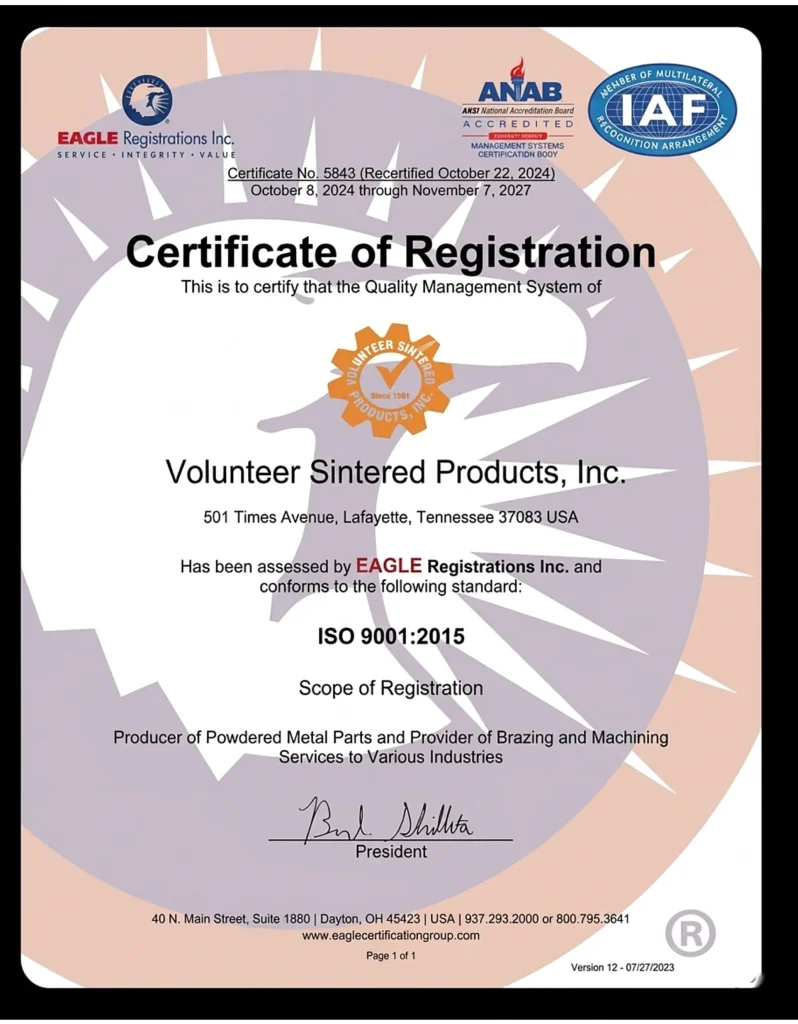
It would be helpful to find out information regarding quality management procedures and certificates the supplier has at the moment. ISO 9001 proves that the supplier has quality management procedures in place, whereas IATF 16949 could be relevant to companies that supply parts for the automotive industry.
Aside from the certificate, it is worth asking about inspection procedures, material verification, dimensional measurements, and mechanical testing of the parts in question, as this could be different depending on the specific component.
The reputable supplier will have no trouble answering your questions regarding quality management procedures and showing relevant documents.
4. Compare Pricing, Lead Times, and Production Capacity
It is important to consider price, although the lowest quotation does not necessarily mean good value. There are a number of reasons why a quotation might vary, which include differences in tooling costs, materials used, inspection, and finishing processes.
When requesting a quotation, insist that all of these costs be included in the detail so you can compare them side-by-side with other suppliers. In other words, do not focus merely on the price.
This is true even about the lead times because you will have to know how much time it takes to make the tools, test the product, manufacture it, and finally deliver it to you.
You may also want to know whether the supplier can handle the volume without affecting the quality of the product.
5. Assess Engineering Support and Additional Services
The value of the supplier is not limited to the production of a particular part. The help of engineers can point out problems in design, increase the manufacturing capability of the design, and eliminate unnecessary costs for production.
Inquire about whether the supplier offers any help with the process of design for manufacturing, prototyping, custom tooling, and selection of materials. It can be helpful to have such services when a new part is being developed, or the design of the part is being modified.
Moreover, you need to see if there are secondary operations offered by the supplier, such as CNC machining, heat treatment, deburring, and surface finishing. Such services offered in one company may avoid possible miscommunications during the production process.
While considering the company Powdered Metal Manufacturing in North Carolina, take into consideration the capabilities of this manufacturer.
Connecting Supplier Research With Your Production Goals
Once you have defined your technical needs, quality needs, and budget, then you should limit your selection to those manufacturers that fit your basic criteria. You should ask for capability data, review project specifications, and assess their responses.
This way, you will not be misled by general statements and can make your evaluation based on facts. Moreover, it will make conversations more constructive since you will ask questions relevant to the component you need.
6. Research Supplier Reputation and Communication
A historical record of the supplier will provide you with information on how the supplier will respond to customer requirements, production issues, and business cooperation. Look for any testimonials provided by the customers, references from the industry, and examples of production.
It is better if you can find out more information directly from some customers who are using services of the company right now regarding the quality of products, delivery conditions, and response to the problem. Reputation is important, but it must help you to evaluate yourself about the technical skills of the supplier.
The communication skills of the supplier must be evaluated too. Evaluate how the supplier will respond to your questions and limitations, and provide updates on the process. When the supplier does not communicate effectively from the start, then it is a warning sign.
Select the supplier who can communicate effectively, document the requirements, and solve the issues.
7. Consider Logistics and Long-Term Reliability
Proximity can affect costs of transport, time of transport, and coordination; however, proximity should not make your decision. In some cases, certain suppliers might provide efficient service to North Carolina from other states, whereas others can have an edge with their regional distribution channels.
Evaluate the transport process, the packaging process, and the schedule for delivery in case of any unforeseen situations. In case of your regular requirement for components, evaluate the supplier’s method of managing the stock during capacity issues.
Keep in mind that you should not focus only on your initial purchase; a good supplier should be capable of delivering repeat orders according to specified requirements and adjusting to changes in those requirements.
Make Your Supplier Decision With Confidence
Selecting powder metal parts suppliers requires taking into account various factors including process knowledge, quality assurance, pricing, communication, and delivery capability. There is no factor that could make this decision perfect. The company whose processes fit your requirements is the right one.
It is necessary to compare offers, to identify your quality requirements, and to discuss volume and delivery before selecting one of the providers. Should you be interested in using Volunteer Sintered Products for your project, you can contact Volunteer Sintered Products with your requirements.
Your evaluation at this stage will help you reduce risks, to guarantee quality of the parts, and to establish relationships with the supplier.